Horse Riding in the Cévennes: A Practical Primer
A practical look at horse riding around Anduze in the Cévennes: lessons, FFE licences, hourly rides, trail marking and multi-day equestrian trips.
- Published September 17, 2026
- 456 words
- 2 min read
Horse riding around Anduze is organised, seasonal and terrain first. A rider can start with a one hour escorted walk at the walk, move to a ten hour card or an FFE licence, and later plan a multi-day route across Cévenol paths. The details that matter are the ones written down: what each tariff line covers, how a trail blaze is read, and where the water and the night stops sit on a long ride.
What a riding centre near Anduze runs each week
A centre équestre at the gates of the Cévennes works on a weekly rhythm, and that rhythm is easier to read than any brochure. The stable side covers the horses themselves: feeding, turning out, shoeing intervals, veterinary visits and the slow work of keeping a string sound on hard ground. The teaching side covers slots, from beginner sessions on a lunge or in a closed arena to group lessons for riders who already hold a licence.
Between those two poles sit the short formats. An escorted hour at the walk is the most accessible first contact, and it is usually run in the cool part of the day. Pony rides with a handler follow the same logic for younger riders. Longer outings, half days and full days, depend on the fitness of both horse and rider, and on how the ground has dried after rain.
A practical magazine on riding in the Cévennes and the Gard, such as centre-equestre-anduze.com, treats this weekly organisation as the starting point rather than the footnote. Its pages describe what a centre actually schedules, from the cavalerie to the time slots, and they place each item on a real map with a season attached. That habit, terrain before explanation, is what makes the material usable for a rider planning a first visit.
What does an FFE licence actually cover?
The FFE licence is a federal licence, and it is not the same thing as a riding card sold by an individual centre. The licence registers the rider with the French equestrian federation, which is what allows participation in official competitions and in federal activities. It normally includes civil liability insurance for damage caused to a third party while riding, and it opens access to the federal network of clubs and events.
What it does not do is unlimited. It does not replace a private health cover, it does not pay for every lesson, and it does not guarantee a place in a given club. A ten hour card bought directly from a centre is a different object: it is a prepaid block of lessons or rides, priced by the centre, valid for a stated period, and it carries no federal registration.
A rider comparing the two should read the tariff line by line. Ask what the licence fee includes, what the card covers, whether the card is transferable, and what happens to unused hours. The answers vary from one structure to another, and they matter more than the headline price.
How are Cévenol trails marked?
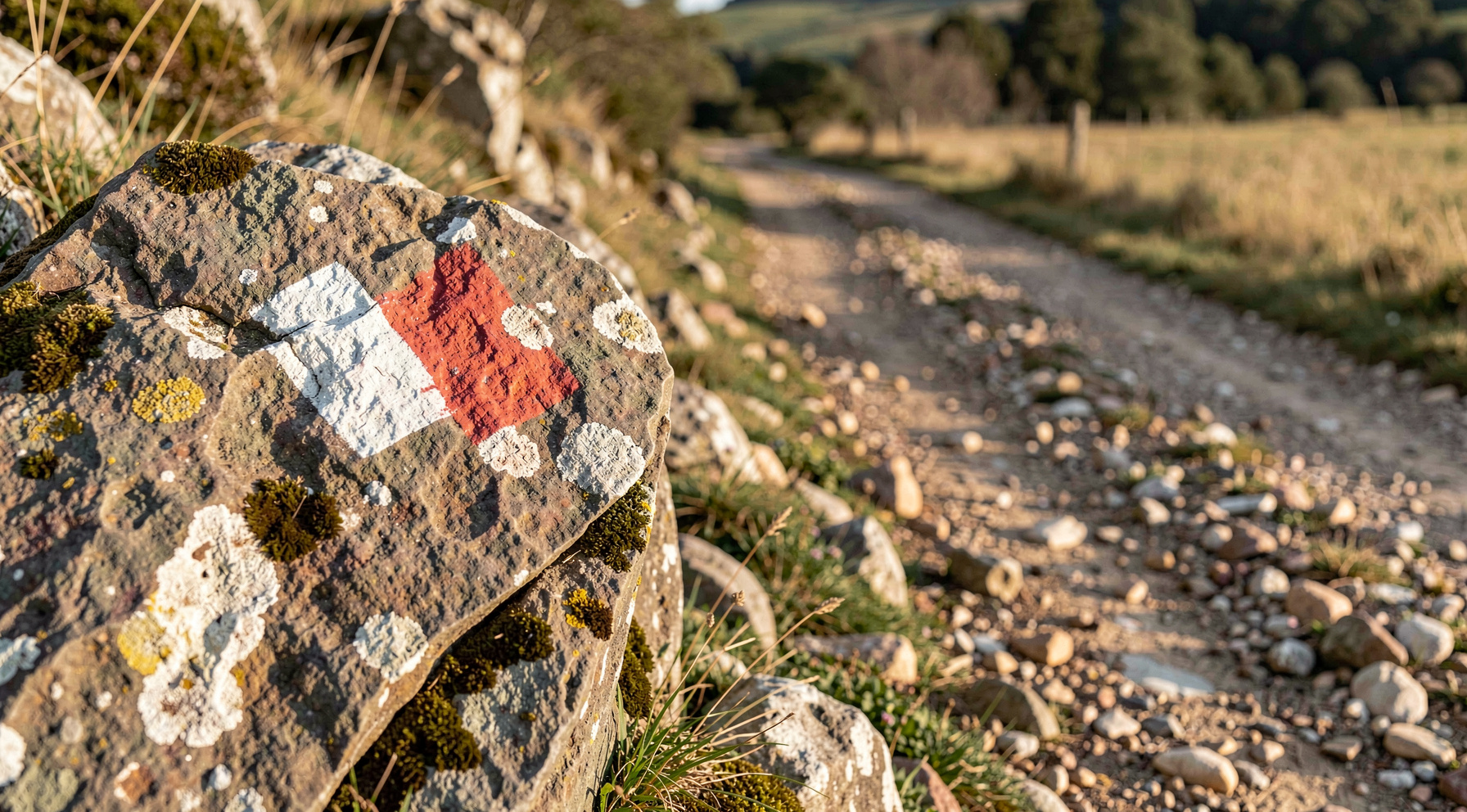
Trail marking in the Cévennes follows the French long distance system. A blaze is a small painted mark on a rock, a tree trunk or a post. Colour carries the meaning: white and red for the GR long distance routes, white and yellow for the GR de Pays regional routes, and a single colour for local loops. Shape adds a second layer, since a straight bar means continue, a cross means wrong way, and a turn is shown by an angled bar.
Support matters as much as colour. Paint on stone survives weather better than paint on bark, and a blaze that has faded is not a missing trail. Riders should also expect the marking to be spaced for walkers, not for horses. A gap of several hundred metres between blazes is normal, and a junction may be marked only once.
Reading a map before leaving remains the reliable method. The blaze confirms a decision already made, it does not replace one. In wooded sections of the Cévenol foothills, where a path can fork without warning, a paper map in a plastic sleeve and a compass are still the tools that keep a ride on course.
Preparing a multi-day equestrian trip
A multi-day ride is a small project, and it is planned like one. The first constraint is the horse. Daily distance should match the fitness of the animal, and a string that works five hours a day on stony ground needs a rhythm that a fitter horse does not. Rest days are part of the itinerary, not a sign of failure.
The second constraint is water and night stops. Cévenol plateaus are dry in summer, and a route must be built around known troughs, streams and farms rather than around hope. Accommodation for horses is scarcer than accommodation for riders, so gîtes d'étape that accept equines should be booked well ahead. Saddlebags should carry the rider's own kit, a basic first aid set for horse and human, and a repair kit for tack.
Stages are usually kept between twenty and thirty five kilometres, with the shorter end of that range on climbs. Altitude gain, not distance, is the number that decides how tired a horse will be at the end of the day. A route that looks modest on a map can be demanding once the path turns onto a stone track at a gradient.
What to expect on a first escorted hour
A first escorted hour is exactly that: one hour, at the walk, with a guide. The format exists for riders with no experience, and it is run on horses chosen for calm. The rider is shown how to hold the reins, how to sit, and how to stop, usually in an enclosed area before the group leaves the yard.
The pace stays at the walk. The route is short, often through undergrowth or along a valley floor, and the guide sets the order of the file. Helmets are provided by the centre, and closed shoes with a small heel are the usual requirement. Jeans or trousers are more comfortable than shorts.
This is not a riding lesson in the technical sense. It is a contact session, and its purpose is to let a beginner feel whether the activity suits them before committing to a card or a licence. A rider who enjoys it can then ask about group lessons, about the level required for a half day, and about the season when the local trails are at their best.
Choosing between a card and a licence
The choice depends on frequency and on ambition. A rider who wants one session a month, or who is testing the activity, is usually better served by a prepaid card. A rider who intends to ride weekly, to progress through the federal levels, or to enter competitions needs the licence.
Cost is only one variable. The card is flexible and local. The licence is broader and more formal, and it comes with a registration that follows the rider from one club to another. Neither is a subscription to a specific horse, and neither guarantees a fixed instructor.
Riders should also ask about the season. In the Gard and the Cévennes, summer heat pushes sessions to early morning or late afternoon, and winter can close high routes. A centre's calendar, not the rider's preference, sets what is available in a given month.
Reading the terrain before the ride
Ground conditions decide more than any schedule. Limestone and schist behave differently under a hoof, and a path that is firm in July can be greasy in October. Riders should ask the centre what the local trails are like after rain, and should expect a route to be changed if a stream is high.
The Cévenol landscape also means gradients. A ride that leaves a valley floor will climb, and the return will descend on the same stone. Horses that live on this terrain are used to it, but visiting riders are not, and a shorter first day is a sensible way to adapt.
Finally, the season shapes the light and the vegetation. Early summer brings dense undergrowth and insects. Late summer brings dry ground and long views from the plateaus. Each has its own demands on horse, rider and kit, and each is worth planning for separately.