What Is Pocket Water in Fly Fishing? How to Read and Fish It
Pocket water is fast stream water broken up by boulders into small, slower pockets where trout rest and feed. Here is how to read it, which methods work, and how to wade it safely.
- Published October 20, 2026
- 1563 words
- 8 min read
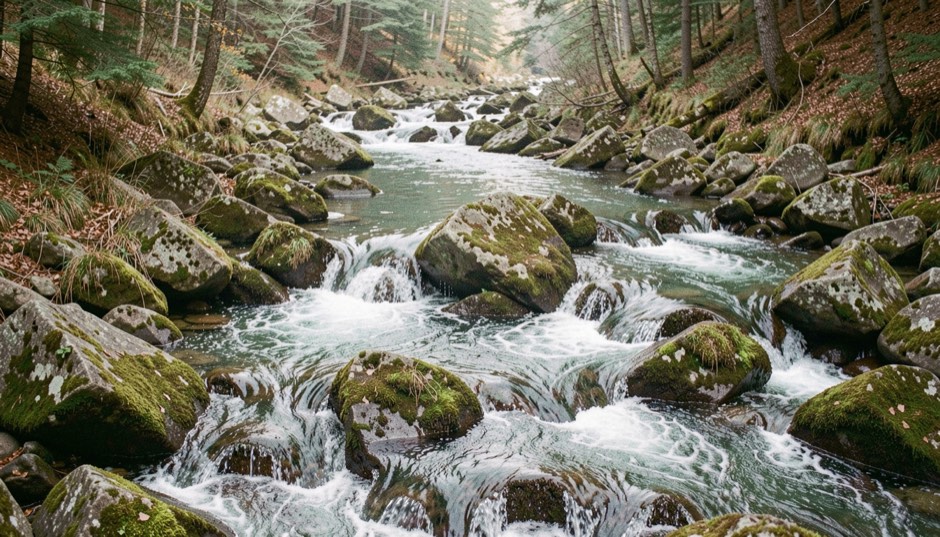
Pocket water is a fast stretch of stream where boulders break the current into small pockets of slower water, usually just in front of, beside, or a short distance behind each rock. Trout hold in those pockets because they can rest out of the main flow while food drifts past on the faster seams next to them. On steep Appalachian mountain streams, long runs look exactly like this, and they fish best with short casts, short drifts and as little fly line on the water as possible.
What is pocket water, exactly?
Anglers use the term for any riffle or run studded with rocks big enough to break the surface or to bulge it from below. Each rock deflects the current. Water piles up against its upstream face, splits around its flanks and leaves an area of slower, often deeper water behind it before the fast flow closes in again. Where many rocks sit close together, guides call the stretch a boulder garden, and the currents turn into a maze of small eddies, tongues and seams.
Pocket water sits between the two water types most anglers learn first: the shallow, evenly choppy riffle and the deep, slow pool. It is fast overall but full of small slow spots, and a single pocket can be no wider than a doormat or as large as a parked car.
Why do trout hold in pocket water?
A trout in moving water balances two needs. It wants to spend as little energy as possible fighting the current, and it wants to stay close enough to fast water to intercept the insects that current delivers. A boulder answers both. The slow water around the rock is a resting place, and the faster lane beside it carries food within a short dart. The broken surface also hides fish from herons, kingfishers and anglers, and tumbling water mixes oxygen into the stream.
That last point matters in the Mountain State. The brook trout, West Virginia's state fish since 1973 and its only native trout, depends on clean, cold, well-oxygenated water. The West Virginia Division of Natural Resources notes that brook trout favor large boulders and woody cover, and that water held above 65 °F for long periods puts them under stress. Shaded, steep, boulder-strewn headwaters are where those conditions last longest, so fishing for wild brook trout in the state often means fishing pockets.
How do you read a run of pocket water?
Stand below the run for a minute before stepping in, and watch the surface. Every change in texture marks a change in speed: smooth, glassy patches are slower water, while a bright, broken surface is fast. Most fish hold in a handful of predictable places around each rock.
| Spot around the rock | What the current does | How to fish it |
|---|---|---|
| Front cushion | Water slows as it piles against the upstream face | Land the fly a few feet above the rock and let it drift in |
| Side seams | Fast water meets slower water along each flank | Fish the slow edge of the seam, not the middle of the fast lane |
| Eddy right behind the rock | Water swirls back upstream against the main flow | Fish can rest here, but the reverse current spoils most drifts; fish its outer edge instead |
| Tail of the pocket | The two seams rejoin and the slack water ends | Often the best lie; drift through the point where the currents meet |
| Plunge below a ledge | Water drops, digs a hole, then slows | Let a weighted fly sink at the base of the drop |
Read the run as a sequence. Fish the closest pocket first, from below, so you do not push fish out of water you have not reached yet. Then take a step or two upstream and fish the next one. A trout in fast water sees the fly for a moment and has to decide quickly, so a few good drifts through each lie tell you most of what there is to know.
Which methods work best in pocket water?
The common thread is line control. Between you and the fly there are usually several currents moving at different speeds, and any fly line lying across them drags the fly almost as soon as it lands. Every effective pocket water method keeps line off the water.
- Short-line or high-stick nymphing. Cast a short distance upstream, lift the rod tip so that only the leader touches the water, and follow the fly downstream with the rod. Tight-line or European nymphing applies the same idea with a long, thin leader and no indicator.
- Dry fly and dry-dropper. High-floating, bushy patterns such as an Elk Hair Caddis, a Stimulator or a Royal Wulff stay visible in broken water. Hanging a small beadhead nymph a short distance under the dry covers the surface and the middle of the water column on one drift, and the dry doubles as a strike indicator.
- Tenkara. This traditional Japanese method was developed for mountain streams. It uses a long telescopic rod, usually somewhere between 10 and 15 feet, with a fixed line tied to the tip and no reel. The long rod and light line make it easy to hold everything except the tippet and fly above the current.
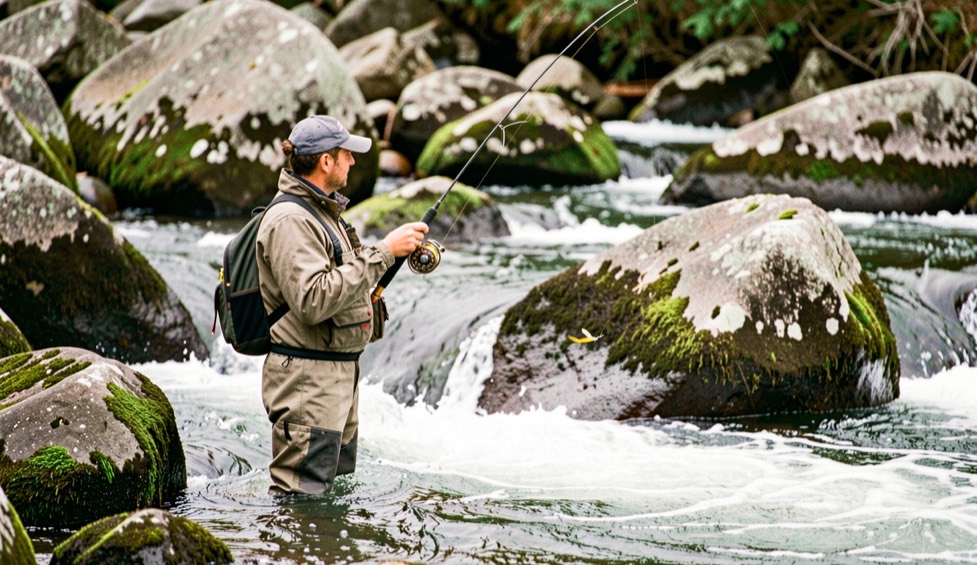
Whatever the method, keep casts short: in many pockets the fish is closer than it looks, and a cast of little more than the rod and leader is enough.
What gear makes pocket water easier?
Rod length matters more than line weight. A longer rod reaches farther over the seams and keeps more line off the water, which is the whole game in broken current. On tight, overgrown creeks a shorter rod is easier to cast under branches, while on open boulder runs extra length gives better control. We weigh those trade-offs for small mountain water in choosing a four-weight rod for mountain creeks.
Leaders can be shorter and a little heavier than the ones used on slow pools, because broken water hides the tippet and fish get less time to inspect the fly. Carry flies in two groups: buoyant dries that ride high in choppy water, and small weighted nymphs that sink quickly enough to reach the bottom of a short pocket. Tungsten beads are denser than brass beads of the same size, so they sink faster, which helps when a drift lasts only a few seconds.
How do you wade pocket water safely?
The rocks that make pocket water productive also make it hard to wade. They are rounded, often slick with algae and spaced unevenly, and the current between them pushes harder than the surface suggests. A few habits reduce the risk:
- Check the flow before you leave home. The U.S. Geological Survey publishes real-time streamflow and gage height for many streams through its national water data service, and a reading well above the usual level for that gauge is a reason to fish somewhere else.
- Carry a wading staff and use it as a third leg, moving only one point of contact at a time.
- Cross sideways to the current with short, shuffling steps rather than long strides from rock to rock.
- Wear boots with soles that grip on wet, rounded stone; we cover what to inspect in wading boots that hold on rocky ground.
- Cinch a wading belt over chest waders to limit how much water gets in if you go down.
- Fish many pockets from the bank or from a stable stance below them instead of wading into the middle of the run.
How does high or low water change pocket water?
After heavy rain the river covers many of the rocks, the small pockets shrink or vanish, and fish slide toward the banks and the larger, deeper slots that still offer shelter. The fishable water gets narrower, drifts get shorter, and heavier flies are needed to get down quickly. We walk through that situation in our notes on nymphing pockets when the river is up.
Low summer water does the opposite: pockets turn shallow and clear, fish see the angler sooner, and early morning becomes the better window. On brook trout streams, carry a thermometer; when the water stays above that 65 °F stress point, rest the fish and come back on a cooler day.
Questions anglers ask about pocket water
Is pocket water good for beginners?
In some ways, yes. Fish in fast water get only a brief look at the fly and tend to take or refuse it quickly, and the casts are short and simple. The hard parts are wading safely and controlling drag across mixed currents, so start on a low, clear day on water you can cross comfortably.
What is the difference between pocket water and a riffle?
A riffle is shallow, fast water over gravel and small cobble with a fairly even, broken surface. Pocket water is fast water interrupted by larger rocks that create separate, slower pockets. A riffle is usually fished with longer drifts down a uniform lane, while pocket water is fished one small target at a time.
How long should each drift be in pocket water?
Only as long as the fly drifts naturally. In a small pocket that may be a few seconds before the faster water grabs the leader. Lift and recast as soon as the fly starts to drag: a short clean drift is worth more than a long one that skates.